Vendor lock-in
Internally, switching backends counts as a project risk: thousands of charge points hang directly off the legacy system, and every change means reconfiguration in the field – so everything stays as it is.

NeLeSo OCPP Broker
The NeLeSo OCPP Broker decouples charge points from backends. Migration, parallel operation and rollback become plannable per charge point – without a big bang or field reconfiguration.
One building block from our software toolkit, usable on its own or as part of a solution we build and test with you.
The problem
Charge points are hard-wired to one target system, protocol levels in the field are mixed, and every fault lands unfiltered in support. Three patterns we have seen in charging parks for years.
Internally, switching backends counts as a project risk: thousands of charge points hang directly off the legacy system, and every change means reconfiguration in the field – so everything stays as it is.
An OCPP 1.6 installed base meets 2.0.1 requirements: new backends, certifications and tenders demand capabilities your existing hardware will never deliver on its own.
Every target system has to know every charger quirk: firmware oddities, vendor dialects and dropped connections hit the backend unfiltered – and end up in the support ticket.
Capabilities
Six core capabilities, one goal: operating charge points and backends independently of each other – proven in live operation with charging network operators.
Messages are routed by rule – per charger, per group or per site. Multiple backends run in parallel without any charge point noticing.
The broker keeps the complete station state on hand: configuration, status, latest meter values. Queries are answered straight from the cache – no hardware round trip.
OCPP 1.6 ↔ 2.0.1 in both directions: existing hardware talks to modern backends without touching firmware or the target system.
Reconnect logic, message queue and auto-resync absorb unstable connections. Charging sessions survive backend restarts and brief network outages.
Logs, events and MeterValues become readable cause-and-effect chains: instead of raw data, your support team sees what happened – and what to do about it.
Built for high session counts per node and proven in continuous operation – horizontally scalable and watched by 24/7 monitoring.
Zero-downtime migration
The broker keeps every charge point connected while the target system behind it changes. Every step is observable, every step is reversible – and your sessions keep running throughout.
Migration path
Deployment models
The identical feature set in all three models. Source code included.
Operated in our cloud: the fastest start, with updates, operations and 24/7 monitoring by the team that built the broker.
In your data center or cloud environment: full data sovereignty, integration with your existing systems, run by your team – with our support.
As an edge appliance on site: for environments without a permanent cloud connection, pre-configured and validated in our test lab.
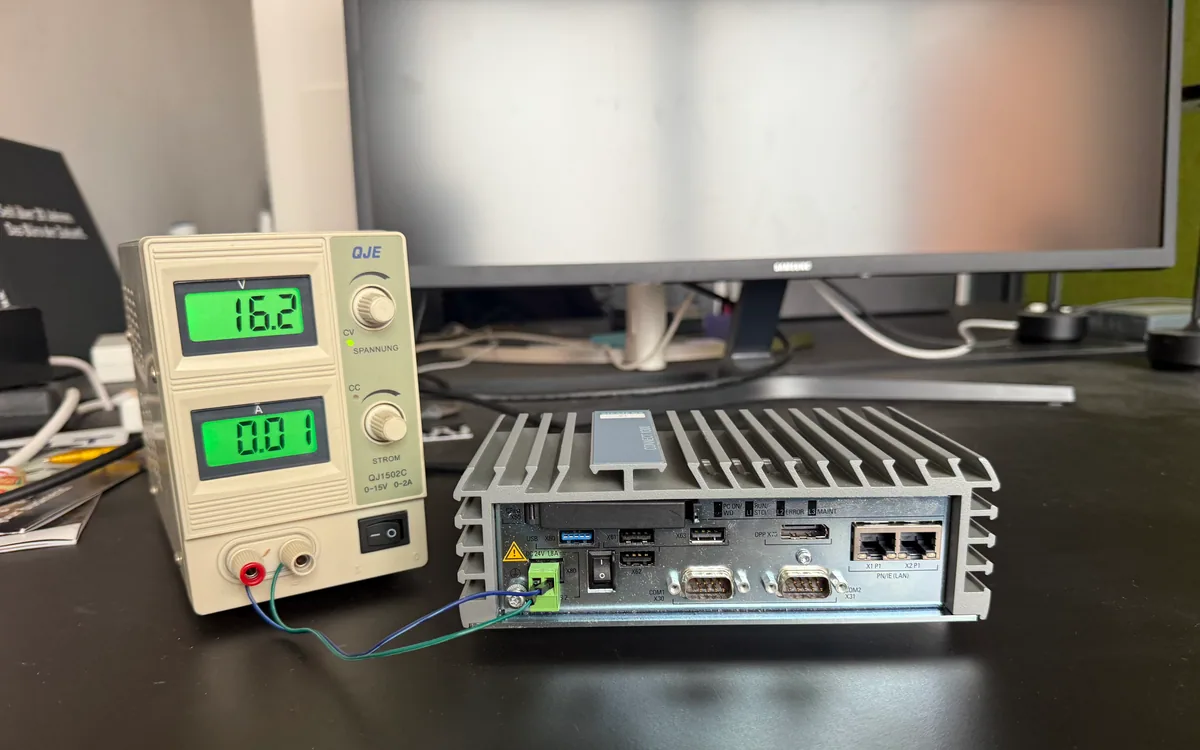
NELESO EDGE APPLIANCE · TEST LAB
Appliance
The edge appliance brings the full broker on site: the same software, the same routing rules, the same digital twin – validated in our test lab before it goes into the field.
FAQ
An OCPP broker is middleware between charge points and OCPP backends. It terminates each charge point connection, keeps the station state in a digital twin and routes messages to one or more target systems based on rules. That makes it possible to switch, run in parallel or test backends without reconfiguring anything on the charge point.
The broker, if you want to keep your current or future backend but become independent of it – for migration, multi-backend operation or protocol normalization. A full CPMS, if you also need an operations portal, tariffs and billing. The two combine well: the broker forms the foundation, and modules from the CPMS toolkit are added as needed.
Typically weeks rather than months – depending on the number of sites and the condition of the installed base. Because the switchover happens per charge point, group or site, the migration can be planned site by site and there is no big bang: shadow connection and comparison operation run beforehand, and rollback remains available at any time.
OCPP 1.6 and OCPP 2.0.1 run in production, and OCPP 2.1 is prepared. The broker normalizes between versions, so existing OCPP 1.6 hardware can be operated against backends that expect OCPP 2.0.1.
Next step